
Research library / Essay
The Hidden Environmental Cost of AI Infrastructure
And Why Architecture Matters
AI infrastructure has an environmental problem — and most of the conversation is focused on the wrong part of the stack.
The discussion tends to center on GPUs: more efficient chips, better cooling, lower power draw per FLOP. These matter. But hardware efficiency is only one lever. The other is software architecture — and it receives far less attention than it deserves.
A typical real-time AI pipeline routes data through multiple services: feature extraction, remote model serving, caching, storage. Each hop requires serialization, network transit, and additional compute. In many production systems, the actual inference step is a fraction of the total resource consumption. The rest is overhead — data moving between services that exist to support inference rather than perform it.
What happens when you collapse that overhead architecturally? Fewer services, fewer network hops, less compute spent on plumbing. The same AI workload on meaningfully less infrastructure. That's the question this piece explores — and why architectural decisions deserve a place in the sustainability conversation alongside hardware and cooling.
The problem
The Hidden Cost of Distributed AI Pipelines
Artificial intelligence is transforming every industry. But beneath the excitement about models and capabilities lies a quieter reality: AI infrastructure consumes enormous amounts of energy and water.
Hyperscale data centers supporting modern AI workloads now operate at unprecedented scale. Clusters containing thousands of GPUs generate immense heat, requiring sophisticated cooling systems that often rely on large quantities of water. As more AI systems come online, communities around the world are beginning to ask an important question: how sustainable is the infrastructure powering this new generation of intelligent systems?
While much attention has focused on hardware efficiency — better GPUs, specialized accelerators, improved cooling — there is another lever that receives far less discussion: software architecture. The way we design data pipelines can dramatically affect how much compute, and therefore energy, those pipelines require.
The Standard Pipeline and Its Overhead
A typical real-time AI pipeline today routes data through multiple separate services, each communicating via network calls:
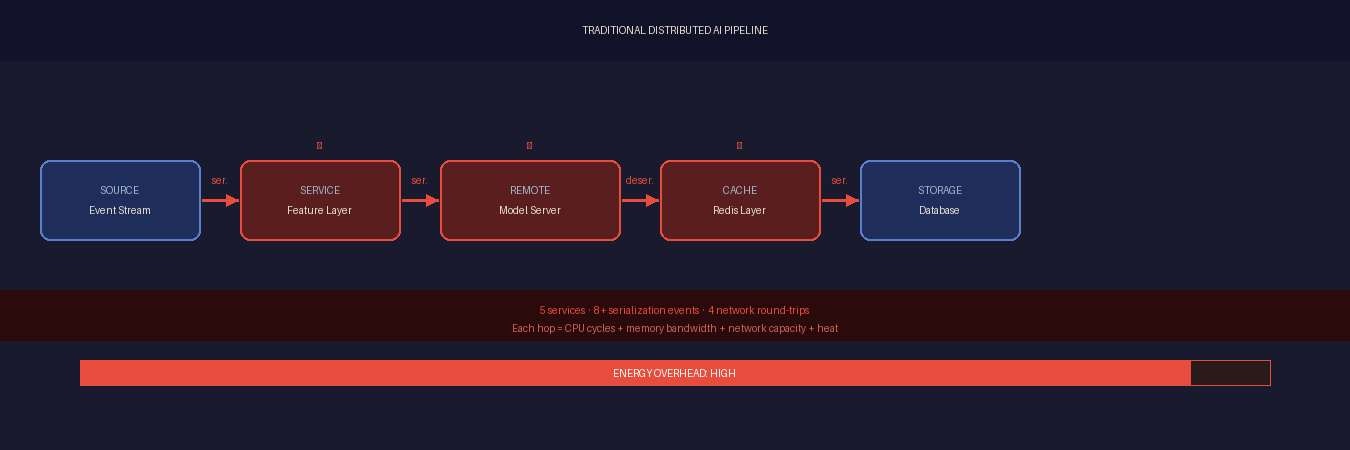
Each stage serializes data, transmits it over the network, deserializes it, processes it, and passes it to the next component. This architecture introduces several layers of overhead:
- repeated serialization and deserialization at every boundary
- network round-trip latency between each service
- queueing and backpressure between pipeline stages
- additional infrastructure for orchestration, scaling, and monitoring
Each of these layers consumes CPU cycles, memory bandwidth, and network capacity — continuously, across thousands of machines. In many systems, the actual AI inference computation is only a fraction of the total resource consumption. The rest is overhead: data moving between services that exist to support inference rather than perform it.
The solution
Efficiency Through Architectural Simplicity
One emerging approach to reducing this overhead is collapsing multiple pipeline stages into a single execution environment. Instead of routing every inference request through a remote model server, inference runs directly inside the streaming runtime — in the same process that handles the event stream.

By executing inference within the same process that handles the stream, several costly operations disappear entirely:
- no remote model-serving layer to maintain and scale separately
- no network hop for inference requests
- no repeated serialization between pipeline services
- fewer intermediate infrastructure components
The result is a pipeline that performs the same AI work with fewer machines, fewer moving parts, and significantly less compute overhead. The useful work — inference — remains. The plumbing disappears.
Environmental impact
Why Efficiency Matters for Sustainability
Energy consumption in data centers scales roughly with the amount of compute infrastructure required to process workloads. More servers mean higher electricity usage, more heat generation, greater cooling demand, and increased water consumption in cooling systems.
When software architectures become more efficient, they reduce the amount of hardware required to deliver the same capability. The cascading effects of that reduction are meaningful at scale:

Efficiency Improvements Compound
Reducing cluster size by 20–30% lowers energy consumption proportionally. Less energy produces less heat. Lower heat reduces cooling demand. Reduced cooling demand decreases water consumption. These cascading effects mean architectural efficiency directly contributes to environmental sustainability.
These are not marginal gains. For large-scale AI deployments processing millions of events per second, the difference between a distributed pipeline and an in-process architecture can represent meaningful reductions in physical infrastructure — and, by extension, in the energy and water required to run and cool it.
Industry context
The Shift Toward Energy-Efficient AI Infrastructure
Major technology companies are already recognizing the importance of efficiency. Microsoft, Google, and Amazon have all announced aggressive sustainability goals for their data centers, including commitments to reduce water usage and carbon emissions.
At the same time, new AI workloads are dramatically increasing compute demand. This creates a tension: the industry wants more AI capability while simultaneously reducing environmental impact. The only way to reconcile those goals is through efficiency improvements across the entire stack — hardware, cooling systems, networking, and increasingly, software architecture.
Software is often overlooked in discussions about environmental impact. But the architecture of distributed systems determines how much hardware those systems require. If the same AI workload can run on fewer servers with fewer network hops and fewer intermediate services, the system becomes more efficient by design — not by optimization after the fact.
Conclusion
Architecture as a Sustainability Lever
The next decade will see explosive growth in AI deployment across industries — from financial services to healthcare to national defense. The infrastructure supporting these systems must scale accordingly. The challenge is ensuring that growth happens responsibly.
Energy-efficient architectures — those that reduce complexity, minimize unnecessary computation, and maximize the useful work performed by each machine — will play an increasingly important role in shaping the future of AI infrastructure.
In that sense, architectural efficiency isn't just a performance optimization. It's an environmental one.
The Bigger Opportunity
Architecture decisions made today at the pipeline design level will determine the physical footprint of AI infrastructure for years. Choosing fewer hops, fewer services, and less data movement isn't just good engineering — it's a meaningful lever on sustainability that the industry has barely begun to pull.