Research library / Visual story
No cloud. No calls home. No compromise.
Most AI inference platforms require internet connectivity, cloud APIs, or managed model registries. StreamKernel was built without that assumption.
The challenge
Regulated environments reject phone-home architectures
Defense, intelligence, healthcare, and critical infrastructure ops can't afford a model that dials out to validate a license or fetch weights at runtime.
Network isolation
SCIFs, classified networks, and OT environments have no egress. Period.
Data sovereignty
ITAR, FedRAMP, and HIPAA restrict where data can travel—or forbid it entirely.
Latency intolerance
Real-time sensor fusion and threat detection can't afford a round-trip to a remote API.
Disconnected ops
Ships, forward bases, and edge sites operate with intermittent or zero connectivity.
How it works
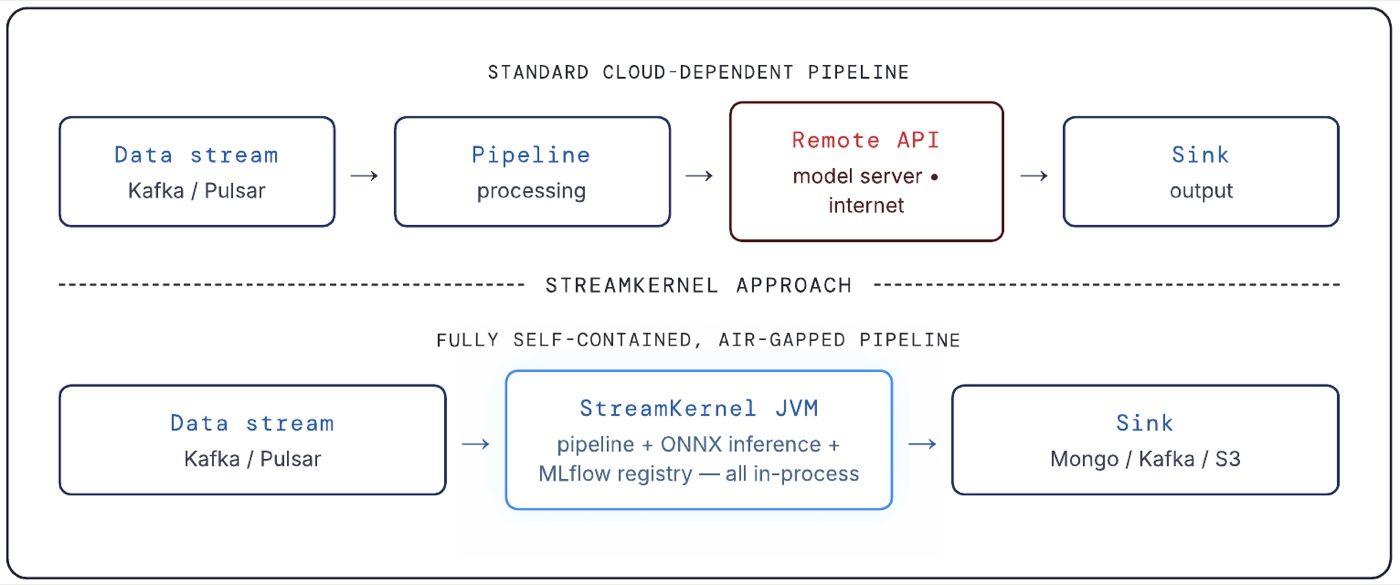
Everything runs in-process. No agents. No sidecars.
StreamKernel embeds ONNX/DJL AI inference directly inside the JVM pipeline runtime — no external model server, no gRPC call, no network hop.
Benchmark evidence
Real numbers from a sealed stack
Validated on a single-node JVM with zero cloud dependencies. These aren't lab conditions — this is the production-candidate configuration.
- Records/sec
AI embedding throughput - 336.8
- Throughput improvement
from baseline run - 28×
- Record loss
at 200K+ docs / run - 0
- Docs/sec avg
raw MongoDB write - 163K
- Model swap cycle
promote → rollback - <30s
- Entire runtime
no external deps - 1 JAR
Air-gap readiness
Every requirement. Checked by design.
No outbound network calls at runtime
ONNX weights and MLflow model files are loaded from local disk or internal registry. Zero internet dependency post-deploy.
Single-JAR deployment artifact
One file. Copy it. Run it. No container registry pull, no cloud bootstrap, no license server ping.
Local MLflow model governance
Promote, demote, and roll back models against an air-gapped MLflow instance. Full lineage. Full audit trail. No Databricks managed cloud.
mTLS + OPA security profile
Validated at 366K ops/sec with TLSv1.3 and OPA policy enforcement active simultaneously. Hardened for classified transport.
Per-event model lineage stamping
Every enriched record carries metadata identifying the exact model version that produced it — auditability without a cloud telemetry pipeline.
Competitive landscape
The rest weren't built for dark environments
| Requirement | Typical ML platforms | StreamKernel |
|---|---|---|
| Runtime connectivity | Required — license server, model hub, or telemetry | None — fully offline after deployment |
| Model governance | Cloud-managed registry (SaaS dependency) | Local MLflow — self-hosted, air-gapped |
| Inference location | Remote API call or sidecar process | In-process, within the JVM — no hop |
| Deployment artifact | Container images + orchestrator + registry | Single JAR, runs on bare JVM |
| Security posture | Varies — TLS optional, policy not enforced | mTLS + OPA enforced at 366K ops/sec |
| Audit trail | Cloud-side logs only | Per-event lineage in every output record |
AI inference at stream speed. Inside the perimeter.
StreamKernel is the only JVM pipeline runtime with embedded ONNX/DJL inference and local MLflow governance — built for environments where the cloud is not an option.
steven.lopez@streamkernel.io