Research library / Brief
The Network Tax Nobody Talks About in Fraud Detection
Most production fraud pipelines pay a hidden cost at the boundary between the event stream and the scoring service. Here is what it costs, and what it looks like when you eliminate it.
- Topic
- Real-Time Fraud Scoring
- Stack
- ONNX · DJL · Kafka · Java 21
- Audience
- Engineers & Architects
The model isn't slow. The network is. Every external scoring call in a payment pipeline is a tax — on latency, on failure surface, on audit complexity. Infrastructure collapse removes the boundary entirely.
Where the Problem Lives
In most production fraud architectures, a payment event travels from the ingestion layer to an external scoring service — a REST call, a gRPC hop, a sidecar container — and back before a decision can be produced. That round-trip is the network tax. It compounds at scale. It introduces failure modes that have nothing to do with your model quality.
And it makes the scored record a derivative of the original event, not a native part of it. The gap between where the decision was made and where the record lives is the source of most audit friction in production fraud pipelines.
- External hops in the scoring hot path
- 0
Policy enforcement, model execution, provenance tracking, and transport all live inside the same controlled runtime. The scored record is produced before the event leaves the pipeline.
What the Demo Does
The real-time fraud scoring profile on the StreamKernel use cases page runs synthetic payment events through two sequential in-process transformers before producing to a Kafka scored transaction topic.
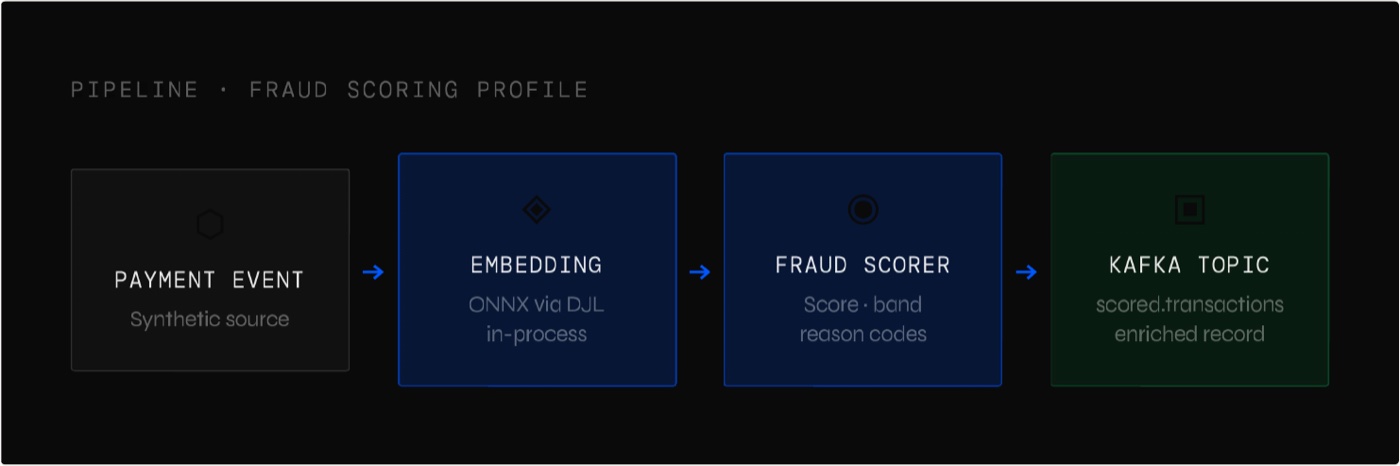
The embedding transformer vectorizes each payment event using an ONNX model loaded directly into the JVM — no external inference server. The fraud scoring transformer produces a decision record. The result lands on Kafka fully enriched.
The output record
Kafka message schema · Scored transaction
fraud_score         0.847
risk_band           HIGH
decision_label      REVIEW
reason_codes        ["velocity","geo_mismatch"]
model_id            fraud-scorer-v2.1
embed_model         all-MiniLM-L6-v2
sk_pipeline_id      sk://fraud/prod/1a2b3c
sk_transform_chain  embed→score→emit
Where the Architectural Boundaries Sit
This is the detail that matters most to architects. Policy enforcement, model execution, provenance tracking, and transport all live inside the same controlled runtime. There is no call out.
No external dependency
The model runs in-process. If your scoring service fails in a traditional architecture, you're either dropping events or making blind decisions. Here, the runtime is the scoring service.
Provenance is structural
Every emitted record carries StreamKernel headers: transform chain, model version, timestamp chain, pipeline identity. No log correlation. No side-channel lookup.
Complete at emit time
The scored record is produced before the event leaves the runtime. Enrichment is not applied downstream — it is native to the pipeline output.
That is what infrastructure collapse looks like in a financial services context — and it is what eliminates the network tax that shows up in most production fraud pipelines today.
For Engineers: What Is Inspectable
The demo is built to be repeatable, not anecdotal. The benchmark matrix row, transform chain configuration, Kafka output schema, and profile definition are all visible on the use cases page.
Technical specifics
Inference layer
- ONNX runtime via DJL — no GPU dependency, full CPU inference
- Intra-op thread budget bounded by physical cores — critical in containerized deployments
- Predictor ownership scoped per transform instance — no shared state
- Model swap without pipeline restart via MLflow watcher
Pipeline topology
- Embedding and scoring are separate transformer implementations, linked in sequence
- Swap the scoring model without touching the embedding layer
- Route embeddings to a different sink independently of scoring output
- Transform chain is declared, not hardcoded — inspectable at runtime
Why It Matters at the Platform Level
For fraud and AML teams, the question is almost never "is the model accurate." It is "can we explain this decision in an audit, a dispute, or a regulatory review — and can we do it without a cross-system forensics exercise."
When provenance is structural — when it travels with the record — that question gets easier. The scored transaction is its own evidence artifact. The decision path is in the headers. The model version is in the record. You do not need to reconstruct context from logs that may have rotated or correlate across systems that were not designed to talk to each other.
The network tax is not just latency. It is also the gap between where the decision was made and where the record lives. Infrastructure collapse closes that gap.
What's Next
The fraud scoring profile is one of several financial services use cases live on the site. Regulatory reporting enrichment, transaction lineage for DORA compliance contexts, and AML pattern tagging with audit-ready output are all architecturally similar — the same in-process inference approach, different transform chains and output schemas.
If you are building a fraud or AML pipeline and the external scoring service round-trip is showing up in your latency budget or your audit overhead, the profile is worth a look. The demo is live. The benchmark is reproducible. The code is inspectable.
Explore the demo
Fraud scoring profile · benchmark matrix · transform chain
streamkernel.io/use-cases →
StreamKernel is a transport-agnostic event pipeline kernel with in-process ONNX/DJL inference, MLflow model management, and multi-sink architecture.
US Provisional Patent Application No. 64/057,035 · Filed May 4, 2026