Research library / Technical whitepaper
Production-Grade Embedding Pipelines with MongoDB Atlas Vector Search
How to run ONNX embedding inference inside a JVM streaming pipeline, write 200,000+ vectorized documents to MongoDB in 10 minutes on a developer laptop, and achieve 28.3× throughput improvement — with zero record loss, no GPU, and no external inference service
- Pipeline Throughput Gain
11.9 r/s → 336.8 r/s - 28.3×
- Docs / 10-min Window
Embedded + written to MongoDB - 200,928
- Pipeline Integrity
Zero record loss, all runs - 100%
- Of Inference Ceiling
Pipeline overhead ≈3% - ~97%
| Audience | Engineers and architects building real-time AI enrichment pipelines |
| Date | April 2026 |
| Status | Technical white paper — April 2026 |
| Benchmark model | all-MiniLM-L6-v2 (FP32 ONNX), CPU-only, Java 21 |
| Sink | MongoDB 7.x, MONGO_VECTOR profile, Atlas-ready schema |
Executive summary
The problem: vector databases are only as good as what feeds them
Vector search is only as useful as the pipeline that feeds it. MongoDB Atlas Vector Search is a powerful platform for semantic query — but it receives value only after embeddings are continuously generated, enriched, and written into collections. For many engineering teams, that upstream work is where the real complexity lives.
StreamKernel is a JVM-native streaming runtime that eliminates that upstream gap. It runs ONNX embedding inference in-process — no Python sidecar, no REST call to a model server, no serialization boundary between inference and persistence. Records flow from source through tokenization, batched ONNX inference, metadata enrichment, and MongoDB bulk write inside a single JVM process.
Core thesis
The hardest part of deploying vector search is not the database — it is the pipeline that fills it.
StreamKernel collapses embedding generation, vector enrichment, and MongoDB persistence into one JVM process. This paper benchmarks that claim across 14 runs and 28.3× of measured throughput improvement.
| Question | Conventional approach | StreamKernel approach |
|---|---|---|
| How are embeddings generated? | Custom pipelines, model services, or customer-built jobs | In-process ONNX inference inside the pipeline runtime |
| Where does complexity live? | Before MongoDB: orchestration, infrastructure, security, DevOps | Collapsed into one deployable runtime boundary |
| How does MongoDB get populated? | Atlas waits until upstream work is solved, often months later | Continuous write path from inference to Atlas, starting immediately |
| What does the operator benefit from? | Multi-service stacks with multiple approval and failure boundaries | One deployable, one log stream, one configuration boundary |
The problem with conventional embedding pipelines
Embedding generation is where production timelines slip
A vector database becomes valuable only after embeddings are continuously generated and delivered into it. For most engineering teams, that means assembling a chain of ETL jobs, embedding services, storage layers, queueing systems, access controls, deployment approvals, observability stacks, and database writes.
This creates a predictable pattern: the database may be ready, but the vector generation path remains bespoke and fragile. The more custom that upstream path becomes, the slower the team moves from proof-of-concept to production.
| Current pattern | Operational burden | Customer impact |
|---|---|---|
| ETL + model service + Atlas | Multiple deployables, multiple teams, multiple failure domains | Longer approval cycles and slower rollout |
| Remote embedding APIs | Network dependency, rate limits, data movement, external vendor risk | Harder for regulated or air-gapped workloads |
| Python inference sidecar | Separate runtime, dependency drift, serialization boundary | More DevOps overhead and more points of failure |
| Batch-only vector generation | Delayed freshness and limited real-time behavior | AI experiences feel stale or incomplete |
The attribution problem
When embedding pipelines are hard to deploy, teams describe the entire vector search initiative as difficult — even when the database layer is working perfectly. The friction lives upstream. StreamKernel is designed to remove it.
Architecture
Architecture: inference inside the pipeline process
StreamKernel is a transport-agnostic, sink-agnostic streaming runtime that runs ONNX embedding inference inside the JVM process. The model loads once at startup through Deep Java Library (DJL) and ONNX Runtime, executes through a configurable predictor pool, and writes enriched records directly to MongoDB through the MONGO_VECTOR sink — all without leaving the process boundary.
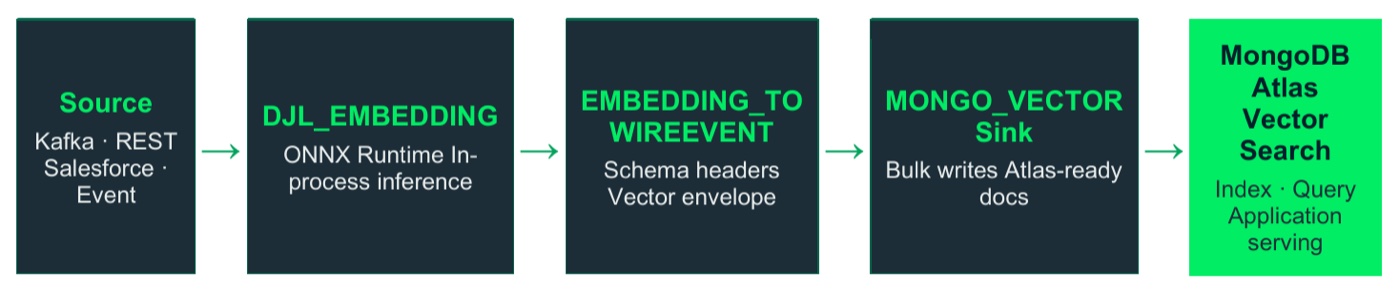
The key architectural choice is the removal of the network hop between pipeline enrichment and persistence. In conventional patterns, records cross process boundaries before and after inference. In StreamKernel, source, embedding transform, metadata transform, and sink execute in one process — with Prometheus/Grafana metrics and enterprise security profiles available around the runtime.
| Layer | StreamKernel role | Value delivered |
|---|---|---|
| Ingestion | Accepts streaming or synthetic/event sources through pluggable source SPI | Continuous vector supply into MongoDB; no batch jobs required |
| Inference | Runs ONNX embeddings in-process through DJL/ONNX Runtime | Eliminates the Python model server and its operational surface area entirely |
| Vector envelope | Adds schema metadata, dimensions, encoding, event IDs, and vector payload | Every MongoDB document carries typed, versioned embedding metadata |
| Persistence | Bulk writes through MONGO_VECTOR into MongoDB collections | MongoDB receives validated, bulk-written vector documents on every batch |
| Observability | Exposes pipeline EPS, integrity, JVM, queue, and sink metrics via Prometheus | Single log stream, single metrics endpoint, single operational boundary to monitor |
Output Document Schema
Every record written by StreamKernel arrives in MongoDB with a consistent, Atlas-indexable schema. The vector_embedding field is named and typed correctly for a MongoDB Atlas Search vector index on first creation:
| Field | Type | Value / Purpose |
|---|---|---|
_id / ticketId | string | UUID v4 — business key as document identity, ready for Atlas filtering |
vector_embedding | Array[384] | Float32 L2-normalized MiniLM-L6-v2 vectors — Atlas vectorSearch path field |
headers.content-type | string | application/x-streamkernel+vec-f32 |
headers.embedding.dims | string | "384" — explicit dimension declaration for index validation |
headers.sk.schema | string | wireevent/vector-f32/v1 — versioned schema identity |
updatedAt | timestamp | Record enrichment time — supports time-range filtering in Atlas queries |
Technical proof
Benchmark evidence: production-relevant throughput, developer-grade hardware
The benchmark series measured all-MiniLM-L6-v2 sentence embeddings running end-to-end through the full StreamKernel pipeline — from synthetic source through inference through MONGO_VECTOR sink — on a developer laptop with Java 21, ONNX Runtime 1.20.0, and MongoDB 7.x Community Edition. No GPU. No hardware changes. 14 runs.
- r/s Baseline
Run 1 — starting point - 11.9
- r/s Optimized
Run 12 — same hardware - 336.8
- Improvement
CPU-only, no GPU - 28.3×
- Record Loss
Across all 14 runs - 0
The most important benchmark result is not the raw throughput number. It is the ratio of end-to-end pipeline throughput to standalone ONNX inference throughput. At short sequence lengths, StreamKernel operated at approximately 97% of the pure inference ceiling. Pipeline overhead — source, queueing, metadata transform, MongoDB vector write, metrics, and JVM management — accounts for only ~3% of total processing time.
What this means in practice
StreamKernel feeds MongoDB with correctly shaped, validated vector documents while keeping the primary bottleneck where it belongs: model compute. The MongoDB write overhead is not the constraint — at 97% of the standalone ONNX inference ceiling, the pipeline plumbing is essentially free.
| Metric | Baseline (Run 1) | Optimized (Run 12) | Why it matters |
|---|---|---|---|
| End-to-end throughput | 11.9 r/s | 336.8 r/s | End-to-end measurement: source to MongoDB write, not just inference |
| Documents / 10 min | 6,720 | 200,928 | Practical production window measurement |
| Pipeline integrity | 100% | 100% | Throughput improved without correctness trade-off |
| Record loss | 0 | 0 | No dropped records across the full benchmark path |
| Heap used (steady state) | ~430 MiB | ~258 MiB | Efficiency improved alongside throughput |
| Pipeline vs. inference ceiling | — | ~97% | Pipeline plumbing consumes ~3% of total time; model compute owns the rest |
Who should use this
StreamKernel is most useful when
StreamKernel is most useful when the blocking problem is not the vector database — it is the pipeline that feeds it. The following scenarios represent the strongest fit:
| Scenario | Without StreamKernel | With StreamKernel |
|---|---|---|
| Custom embedding models | Each team builds and maintains a custom embedding generation stack | Reusable runtime for ONNX model execution and Atlas-ready vector delivery |
| Internal approvals / security review | Each service requires separate approval, CVE tracking, and runbook | Reduces deployables and narrows the operational boundary to one runtime |
| Latency-sensitive AI | REST calls to embedding APIs introduce per-record network latency | Runs inference and MongoDB writes in one process path, no network boundary |
| Data governance / residency | Records leave the network boundary for embedding, creating audit gaps | Supports fully local, private, or cloud-contained inference without external calls |
| Observability | Root cause analysis requires correlating logs across 3+ services | Prometheus/Grafana-first operational view: EPS, sink writes, integrity, JVM |
The architecture bet
The conventional embedding stack has at least three moving parts: a data source, a model server, and a database. StreamKernel collapses those into one JVM process.
Fewer moving parts means fewer failure modes, fewer deployment approvals, fewer log streams to correlate, and fewer SLOs to define. That operational simplicity is not a feature — it is the architecture.
Technical alignment with MongoDB Atlas
Why MongoDB Atlas is the right sink for this architecture
StreamKernel’s MONGO_VECTOR sink is not a generic database writer. It is designed specifically to produce Atlas-indexable documents: explicit field naming, correct vector payload encoding, schema version headers, and bulk write optimization. The pipeline and the database are designed to hand off cleanly — StreamKernel ends where Atlas begins.
| Atlas capability | How StreamKernel prepares records for it |
|---|---|
| Increase Atlas Vector Search adoption | Shortens the path from customer data to searchable vectors in Atlas |
| Improve customer time-to-value | Reduces the number of custom services required before Atlas is useful |
| Support proprietary model customers | Customers bring their own ONNX-compatible embedding models without rebuilding ingestion |
| Strengthen enterprise AI narrative | Connects ingestion, inference, and vector persistence into a credible reference architecture |
| Reduce field friction for CS and SA teams | Provides a concrete, reproducible pattern for upstream vector generation |
The division of responsibility is clean: StreamKernel owns data motion, inference, and vector materialization. MongoDB Atlas owns indexing, querying, hybrid search, filtering, and application serving. Neither system tries to replace the other.
Reference architecture
MongoDB Atlas-ready vector pipeline
A production-oriented StreamKernel + MongoDB architecture can be packaged as a reference implementation for teams that want to operationalize vector search without introducing a dedicated model-serving layer.
| Stage | Reference component | Production consideration |
|---|---|---|
| Data source | Kafka, REST, Salesforce, Pulsar, or synthetic/test source | Use customer’s existing ingestion path; StreamKernel is transport-agnostic |
| Embedding transform | DJL_EMBEDDING with ONNX Runtime | Tune pool size and intra-op threads within CPU core budget |
| Vector envelope | EMBEDDING_TO_WIREEVENT | Attaches dims, type, encoding, schema version, and event identity to each record |
| MongoDB sink | MONGO_VECTOR | Bulk writes to Atlas-ready collection; configurable business key as _id |
| Search layer | MongoDB Atlas Vector Search | Create vector index on vector_embedding field; query via Atlas-native $vectorSearch |
| Observability | Prometheus + Grafana | EPS, queue depth, integrity, JVM heap, MongoDB sink write rate — all pre-wired |
| Security | OPA/mTLS capable profiles | Validated at 366K ops/sec with mTLS + OPA; PERMIT_ALL for benchmark mode only |
Clean handoff point
StreamKernel’s job ends when the vector document is durably written to MongoDB. Atlas’s job begins there: indexing, querying, hybrid search, filtering, and serving results to applications.
The boundary is deliberate. StreamKernel does not attempt to replicate Atlas capabilities. It produces the documents Atlas needs, in exactly the shape it expects.
Recommended use cases
Where StreamKernel is most compelling
| Use case | Fit | Reason |
|---|---|---|
| Real-time support ticket enrichment | High | Short text, frequent updates, strong MongoDB document model fit |
| Internal enterprise semantic search | High | Custom data + custom governance + Atlas Vector Search = natural pairing |
| RAG ingestion pipelines | High | Embeddings must be generated before retrieval quality exists; real-time freshness matters |
| Regulated or private AI workloads | High | Local inference avoids external API dependency; supports air-gapped and data-resident deployments |
| Long-form document embedding | Medium | Supported, but sequence length dominates CPU throughput; INT8 quantization recommended |
| GPU-scale embedding farms | Selective | StreamKernel can orchestrate and feed Atlas, but GPU model servers may own raw inference |
What comes next
Planned work and reproducibility
The benchmark results in this paper are reproducible on any comparable hardware. The following assets are planned to make that reproduction straightforward and to extend the benchmark to additional configurations:
| Next asset | Purpose |
|---|---|
| Atlas demo runbook | Show before/after collection state, vector document schema, Atlas vector index creation, and $vectorSearch queries against StreamKernel-produced vectors |
| Reference repository | Clean MongoDB-focused configuration with repeatable commands, Docker Compose stack, and documented property tuning guide |
| Grafana dashboard bundle | Pre-built panels for vector throughput, Mongo sink write rate, integrity, queue depth, and JVM behavior — importable and shareable |
| Customer architecture diagram | Communicate where StreamKernel sits relative to Atlas, blob/object storage, and end-user applications |
| INT8 benchmark follow-up | Show additional CPU efficiency gains where quantized models are acceptable; sweep data suggests 1.3×–1.6× improvement at production sequence lengths |
Conclusion
The in-process architecture delivers on its promise
The benchmark series in this paper documents what is possible when ONNX inference runs inside the pipeline rather than beside it. A developer laptop. Java 21. No GPU. 14 runs. 28.3× throughput improvement from a starting point of 11.9 records per second to 336.8 records per second — with 100% pipeline integrity across every run and zero record loss.
The architectural lesson is not specific to this benchmark. Any team building a real-time embedding pipeline — for MongoDB Atlas or any other vector database — faces the same upstream friction: model servers to deploy, serialization boundaries to manage, network latency to absorb. Collapsing that into a single JVM process is not a micro-optimization. It is the architecture.
Results summary
28.3× throughput improvement — 11.9 r/s → 336.8 r/s
200,928 embedded documents written to MongoDB in a single 10-minute run
100% pipeline integrity and zero record loss across all 14 benchmark runs
~97% of standalone ONNX inference ceiling — pipeline overhead is ~3%
CPU-only. Developer laptop. Java 21. No GPU. No external inference service.
One process. One log stream. One operational boundary.
Appendix: benchmark context
Test Environment
| Parameter | Value |
|---|---|
| Hardware | 12-logical-core CPU, Windows 11 Pro, High Performance power plan, PCIe ASPM off |
| Java | OpenJDK 21 (Eclipse Temurin), ZGC, 4 GiB heap |
| ONNX Runtime | 1.20.0, CPU execution provider, ALL_OPT optimization level |
| DJL | 0.32.0, OnnxRuntime engine, native singleton |
| Model | all-MiniLM-L6-v2 FP32 ONNX export, 384-dimensional output, L2-normalized |
| MongoDB | 7.x Community Edition, Docker, localhost:27017, MONGO_VECTOR sink, bulk writes |
| Pipeline | parallelism=16, pool=1, intra-op threads=6, flush=25ms, payload=96 chars (SUPPORT profile) |
Key Technical Findings
| Finding | Implication |
|---|---|
| Input sequence length dominates throughput | Short text workloads (support tickets, queries, log lines) achieve the highest throughput |
| CPU thread budget must be respected | pool × intra-op-threads should stay within available core count; violations regress throughput severely |
| Pipeline overhead is bounded and small | StreamKernel reaches ~97% of standalone ONNX throughput; database write overhead is ~3% of total time |
| Correctness is invariant | All 14 benchmark runs reported zero drops and 100% pipeline integrity, including misconfigured runs |
| Atlas vector search remains downstream | StreamKernel produces correctly shaped vector documents; MongoDB Atlas indexes and queries them via $vectorSearch |
Benchmark results reflect the test environment described above. Results on other hardware will vary. This paper is not a MongoDB-endorsed performance claim. All benchmark runs were conducted by StreamKernel Engineering.